


Price: $1,799.99
(as of 2026-10-26 01:28 GMT+0000 – Details)

Imaging Sensor and Lens
The camera centers on a 20.1‑megapixel 1‑inch type CMOS sensor paired with a bright f/1.8‑2.8 zoom lens that covers a 24‑100 mm equivalent range. This combination delivers sharp, vibrant still images even in low‑light conditions, allowing users to capture detailed indoor scenes, evening street photography, or sunrise landscapes without resorting to a bulky interchangeable‑lens system. The sensor’s relatively large surface area for a compact body contributes to reduced noise at higher ISO settings, while the fast maximum aperture at the wide end helps maintain shallow depth‑of‑field effects for subject isolation. Together, these optics and sensor characteristics make the device suitable for everyday photography where image quality matters but portability remains a priority.
4K Video Capabilities
Video capture is a core strength, offering 4K UHD recording at 30 fps with no sensor crop, so the full wide‑angle field of view is preserved for vlogging or cinematic B‑roll. The flip‑up touchscreen rotates 180 degrees, giving the operator a clear view of framing while speaking to the camera, and an external 3.5 mm microphone jack permits higher‑quality audio than the built‑in stereo mics. The camera can also live‑stream directly to compatible platforms via its Wi‑Fi link, simplifying real‑time content creation. These features combine to make the unit a practical tool for solo creators who need reliable 4K output without additional rigging.
Autofocus and Continuous Shooting
The autofocus system employs a contrast‑detect mechanism with face‑and‑eye detection, delivering quick lock‑on for both stills and video. In practice this translates to reliable tracking of moving subjects such as children, pets, or athletes, while the continuous shooting mode reaches up to 20 frames per second in RAW+JPEG burst, giving a generous buffer for decisive moments. The touchscreen can be used to select focus points instantly, and the camera’s minimal shutter lag helps capture spontaneous expressions. However, the contrast‑based approach may struggle in very low contrast scenes compared with phase‑detect systems found in larger bodies.
Wireless Connectivity and Sharing
Built‑in Wi‑Fi and Bluetooth enable seamless transfer of images and clips to a smartphone through the Canon Camera Connect app. Once paired, users can browse the camera’s gallery, select files, and push them to the phone for immediate editing or social‑media posting without cables. The Bluetooth link maintains a low‑power connection for remote shutter control and automatic geotagging, while the Wi‑Fi channel handles bulk transfers at up to 802.11n speeds. This wireless workflow is especially valuable for travelers who want to back up content on the go or for vloggers who need to publish quickly from a mobile device.
Bundle Contents and Practical Power Management
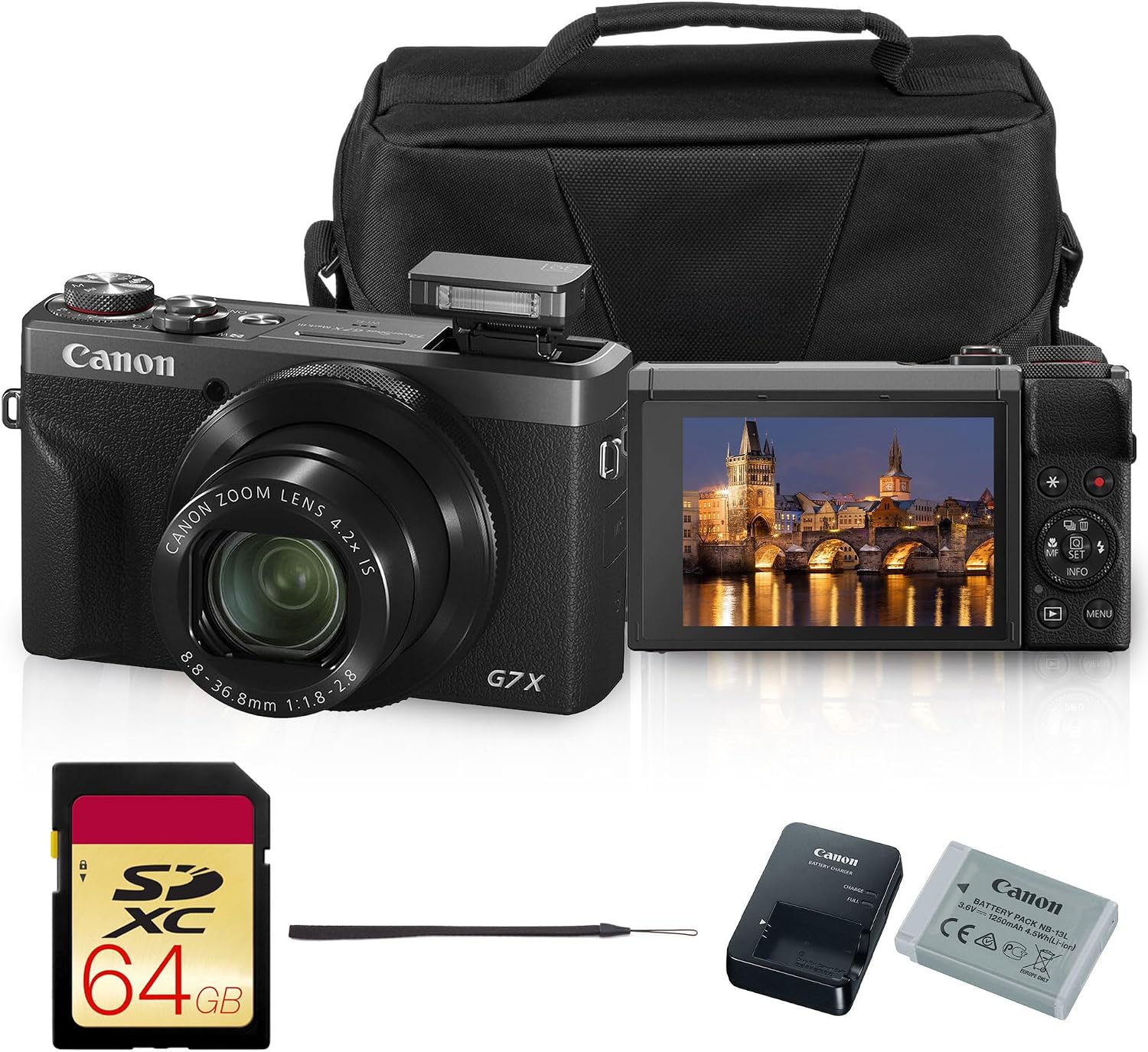
The retail bundle ships with the camera body in black, a NB‑13L lithium‑ion battery pack, the CB‑2LH charger, a WS‑DC12 wrist strap, a shoulder bag, and a 64 GB SDXC memory card. The included battery is rated for approximately 265 shots per charge under CIPA standards, which is adequate for a day of mixed shooting but may require a spare for extended video sessions. The charger plugs into a standard AC outlet and recharges the pack in roughly two hours. The wrist strap and shoulder bag provide basic protection and carrying convenience, while the 64 GB card offers enough capacity for several hours of 4K footage or thousands of JPEGs before off‑loading.
Design, Ergonomics, and User Interface
The body measures roughly 105 × 61 × 41 mm and weighs about 304 g with battery and card, making it pocketable for a compact camera class. A 3.0‑inch tilting touchscreen with 1.04 million dots serves as the primary interface, supporting tap‑to‑focus, swipe navigation, and on‑screen settings adjustments. Physical controls include a mode dial, a customizable function button, and a dedicated movie‑record button, allowing quick switching between photo and video modes. The ergonomics favor one‑handed operation, though users with larger hands may find the grip shallow during prolonged shooting. The menu system is logically organized, and the customizable My Menu page lets frequent settings be accessed with a single press, reducing the need to dive into sub‑menus during fast‑paced shoots.
Practical Considerations and Limitations
While the G7 X Mark III excels as an all‑in‑one creator tool, several practical limits should be noted. The fixed lens cannot be swapped, so focal‑length flexibility is confined to the built‑in zoom range. Battery life, while acceptable for stills, drops noticeably during continuous 4K recording, often requiring a second pack for long events. The contrast‑detect autofocus, though fast, may hunt in very low light or with low‑contrast subjects. Finally, the lack of a headphone jack means audio monitoring during recording must rely on the camera’s internal meters or an external recorder. Potential buyers should also consider that the camera’s maximum video bitrate tops out at 120 Mbps, which is sufficient for most online platforms but may limit professional grading workflows. These factors influence whether the camera matches a specific workflow.